
A core values quiz helps you name the priorities you want guiding your choices. Start with our free quiz, then rank your top five and test them against decisions you actually face. Take the free core values quiz to get a starting set of values to work with.
You’ll leave with a ranked shortlist, a way to handle competing priorities, and actions to try over the next month. Treat your result as a starting point for reflection, not a final answer about who you are. Keep the results beside a recent personal or work decision as you read. That makes it easier to compare the words on your screen with the choices you made.
Know What Your Quiz Results Describe
Personal values are priorities you use to choose how to act. Learning can be a value; finishing a course is a goal, and studying in the morning is a preference. The value points to what matters, while the goal and preference describe an outcome and a way of getting there.
Personal and work values can overlap, but they show up in different settings. Autonomy might mean choosing how to spend an evening at home and having discretion over how you complete an assignment. Naming what an action serves helps you decide whether it deserves time when your schedule is full.
Values also differ from character strengths. The VIA framework describes character strengths as dimensions that can shift with time and circumstances. That finding concerns character strengths, not the accuracy of this quiz. A systematic review examined 43 explicit values-clarification methods tested in randomized trials. That review does not establish whether the quiz linked here accurately identifies your values.
Narrow Your Results to a Ranked Top Five
Use this exercise with your quiz results or on paper. The quiz gives you a starting set; these steps help you narrow and rank it for your own life.
- Answer these six prompts in a few words or a sentence each:
- When did a recent choice feel right?
- What bothered you recently?
- What did you protect when time was tight?
- What would you keep doing without recognition?
- What matters in an ordinary workday?
- What are you willing to give up convenience for?
- Underline the priorities in your answers and collect up to ten candidate values. If you need words for your answers, use the core values list to find a closer match.
- Give each candidate a plain definition beginning “For me, this means…” Merge words only when they mean the same behavior to you. For example, keep “freedom” and “autonomy” separate if one means control over your schedule and the other means choosing how you do a task.
- Keep five by asking which priorities you would protect during a busy, ordinary week. Put values you admire but have not yet tested on a separate note. You can revisit them after you have more experience to compare.
- Compare each of your five values with every other one. Use a realistic choice, such as whether to take on extra work or keep an evening free, rather than asking which value sounds better. Give the value you would protect one point for each comparison. Sort by points; if values tie, break the tie using the choice you are facing now.
Copy this worksheet into a document. Print it or save it as a PDF if you want a paper assessment.
| Value | Personal meaning | Comparison points | Final rank |
|---|---|---|---|
Check Whether Those Values Feel Like Yours
A useful value changes a small decision. Check your shortlist against recent choices before treating it as yours.

- Look at three recent decisions. For each one, write what you chose, what you gave up, and which proposed value the choice served. Include ordinary choices, such as protecting an evening or taking on extra work.
- Check your emotional reactions as clues, not verdicts. When you felt pride, resentment, or disappointment, ask what mattered to you in that moment. Then consider another explanation: were you tired, under pressure, or responding to someone else’s expectations?
- Separate lack of opportunity from lack of commitment. A demanding week may leave little room for an action you care about. Before rejecting the value, look for the smallest expression that fits the time you have.
- If a result feels wrong, ask: Who taught me this mattered? Would I choose it without approval? What cost am I personally willing to accept? An inherited value can still be one you deliberately choose.
Jordan selects achievement, but recent choices show that dependable family time has mattered more. Jordan can rewrite the meaning of achievement to fit the evidence, or replace it with connection, then test that choice against the next few decisions. Use the mood tracker to record reactions you want to revisit alongside your decisions.
Choose When Two Values Pull in Different Directions
When two values pull in different directions, do not settle the choice by comparing their names. Work through the actual options.
- Name the options you can choose between.
- Write what each value needs in this specific situation.
- Set a minimum acceptable condition for each value.
- Choose the option that protects the higher priority while leaving some room for the other.
AHRQ's healthcare decision guide advises people to identify what matters most when they cannot get everything they want. The same prioritization question can help you think through a work choice, without treating a healthcare guide as evidence about career decisions.
Luis is choosing between a role with changing hours and one with fixed hours and a flexible work location. He defines security as dependable hours and freedom as control over where he works. The second role has fixed hours and lets him choose his work location, so it meets his minimum conditions for both values. He chooses it and schedules a review after four weeks to check whether the arrangement works in practice.
The ranking alone cannot make this decision. The meaning Luis gives each value and the actual terms of each role determine which option fits. The VIA Institute advises against using its character-strength results for personnel selection or placement. Use your own values results to prepare questions about a role, then examine its duties and conditions before deciding.
Put Your Five Values to Work Over 30 Days
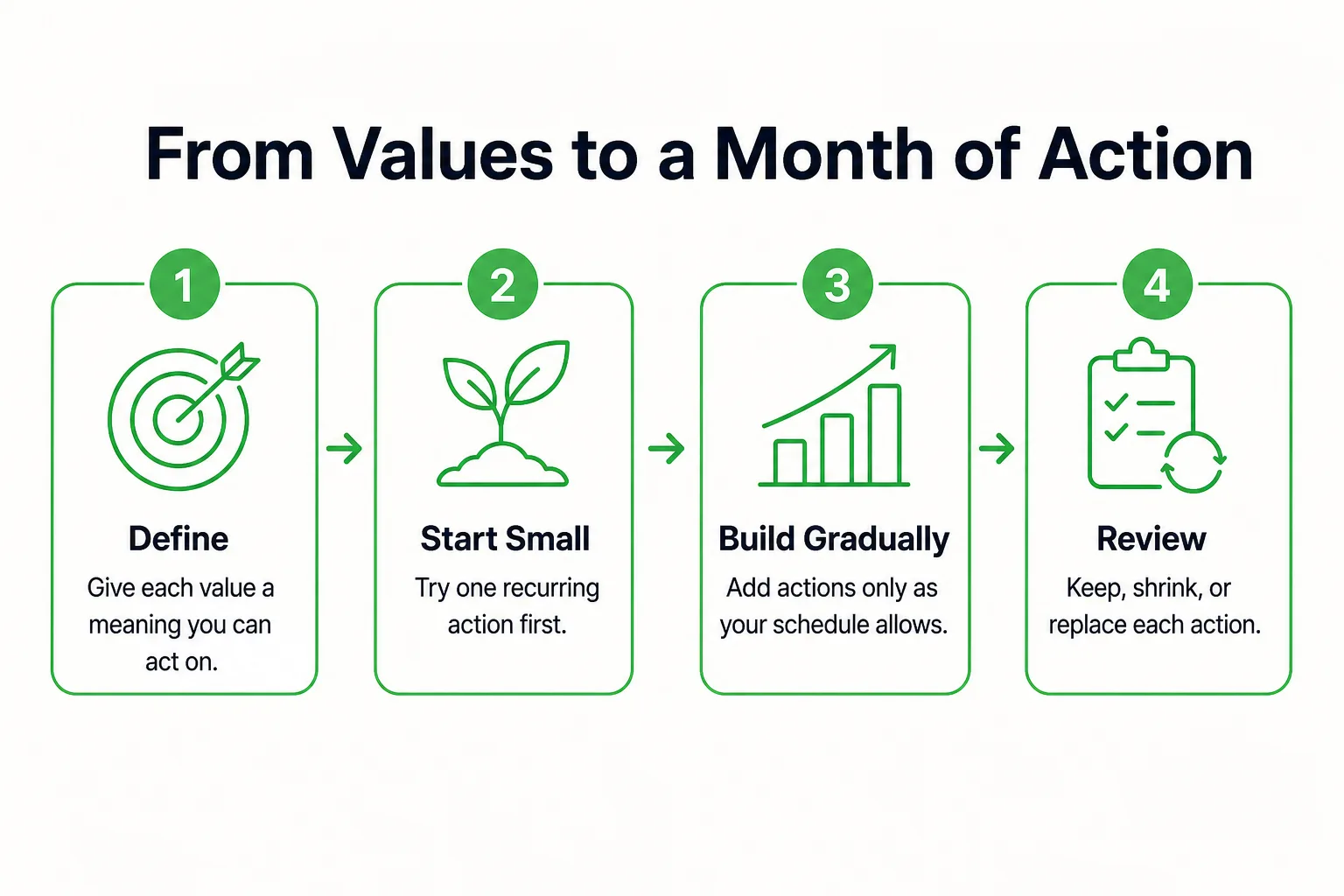
Give your five values a month of practical testing. Substitute your own values for the examples below, and start with one recurring action rather than adding every entry at once.
| Value | Small habit | One-off task | 30-day goal | Focus session |
|---|---|---|---|---|
| Health | Walk after lunch | Choose a walking route | Complete the walks you schedule | Reserve 10 minutes to plan walks |
| Connection | Send a thoughtful message | Arrange a meal | Meet twice | Spend 15 minutes making plans |
| Learning | Read one page | Choose a resource | Finish a short lesson | Study for 20 minutes |
| Freedom | Leave a little space in your calendar | Choose a self-directed project | Complete that project | Set aside 30 minutes to work on it |
| Security | Review the week’s plans | Organize essential household information | Keep up a brief weekly planning habit | Spend 15 minutes reviewing the week |
Use this schedule to try the actions without turning the month into an all-or-nothing test:
- Days 1-3: Define what each value means in your own words, then choose actions that express it. Pick one recurring action to test first. If choosing it feels difficult, use the keystone habit finder to explore a starting habit.
- Days 4-10: Try that one small recurring action. Make it specific enough to know when you will do it.
- Days 11-24: Add other actions only as your time and energy allow. Keep the first action if it fits; adjust it if it does not.
- Days 25-30: Review what happened and decide what to keep, change, or drop.
If you miss a day, resume at the next planned opportunity. If an action repeatedly does not fit, reduce it until it works in an ordinary week.
At the end of each week, ask: What expressed this value? What competed with it? Was the action small enough? What will I change next week?
Turn Your Values Into Actions With Loggd
Return to the core values quiz when you want to revisit your starting priorities, then turn your chosen actions into habits, tasks, goals, and focus time in Loggd.
For example, if learning matters to you, create a goal to finish a chosen course unit. Schedule a reading habit on days that suit you, add a one-off task to choose the next lesson, and run a focus session for the study block. In Loggd, tasks and focus sessions connect with goals. Use task priorities and tags to organize the work around them.
Set a flexible schedule for the reading habit, then use the daily check-in to briefly note whether your actions matched what learning means to you. At the weekly review, compare what you completed with your personal definition. Adjust the schedule if it did not fit your week.
Daily check-offs fill a grid of your last 365 days, giving you a longer view of your activity. Use it to notice patterns, not to judge your worth by a streak or a blank day. The useful question is whether your actions expressed the value you chose.
Loggd is free on iPhone, Android, and the web, with no credit card needed. The browser quiz is separate from the app: browser tools need no signup and save privately on your device.
Questions About Core Values Quizzes
Can my core values change over time?
They can. A change in your circumstances may shift what you want to prioritize, or a value you once chose may no longer fit the life you are building. Revisit your definitions when your choices repeatedly point in a different direction.
Should partners or coworkers have the same core values?
No. People can care about different things and still make decisions together. Share the needs behind your values, then look for an agreement that respects each person’s priorities, such as setting both dependable time together and room for individual plans.
Can I take a core values quiz without sharing my results?
Yes. You can use your results for private reflection and copy them into your own notes or worksheet. The free browser tools need no signup and save privately on your device.
Sources
- Guidelines for Use and Interpretation
- Clarifying Values: An Updated and Expanded Systematic Review and Meta-Analysis
- Help People Use Health Care Quality Information To Make Decisions